
When Avatars Overhear: How Cautiously Do Young People Share Personal Information in the Metaverse?
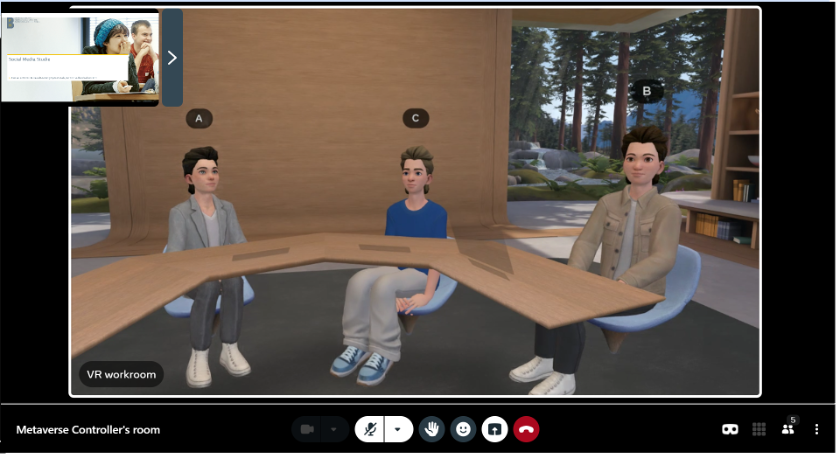

Young people may be more likely to open up in the metaverse if a third avatar is quietly present in the room. This is an initial finding from a small sample taken in an interdisciplinary study by the Departments of Business, Engineering and Computer Science, and Social Work at Bern University of Applied Sciences on self-disclosure behavior in virtual spaces.
Two young people are talking in a virtual room. Their avatars are seated at a table, with a mountain landscape and a lake in the background. They talk about their use of social media, about stress at school, and about personal experiences. A third avatar is in the same room, slightly off to the side. Whether this person can listen in remains unclear: virtual environments lack the familiar cues that tell us how far our voice carries and who is actually listening. In the physical world, we regulate our conversational behavior intuitively when another person is within earshot. We lower our voices, change the topic, or wait. In virtual worlds, however, these cues are unreliable: avatars can appear present without actively listening, and the reach of conversations is often not transparent to those involved. Whether and how the immersiveness of the technology additionally shapes this behavior is an open research question. It becomes particularly relevant when the conversation partners are adolescents. How, then, do young people regulate what they reveal about themselves in immersive virtual environments?
Why adolescents are particularly at risk
The metaverse is becoming a key platform for social interaction (Dwivedi et al., 2022), and adolescents are among its most active user groups. A nationally representative study of more than 5,000 US adolescents shows that young people already use VR platforms regularly and are exposed to specific risks such as sexual harassment and grooming (Hinduja & Patchin, 2024). At the same time, adolescents are in a developmental phase in which the neural maturation of the prefrontal cortex is not yet complete, which limits their capacity for risk assessment and impulse control (Steinberg, 2008). Self-disclosure, the sharing of personal information, is central in this stage of life for identity formation and for building close relationships with peers (Vijayakumar & Pfeifer, 2020). In digital spaces, however, this can become problematic: a meta-analysis shows that cyberbullying among children and adolescents is associated with externalizing and internalizing behavioral problems and is reinforced by increased internet use (Marciano et al., 2020).
The metaverse does, however, offer real opportunities: it enables social encounters across national borders without the need to travel (Hennig-Thurau et al., 2023). The problem lies not in the technology itself, but in the fact that current VR platforms have hardly any youth-specific safeguards. Existing data protection laws were not designed for immersive environments, in which non-verbal and biometric data can be captured alongside text and images (De Cicco et al., 2024). Adolescents move within virtual worlds developed for adults, without adequate tools to assess who might be listening in on their conversations.
Our study with adolescents
To investigate these questions empirically, an interdisciplinary research team at Bern University of Applied Sciences conducted a study involving approximately 90 adolescents aged 14. The project brings together expertise from three departments: Business (information systems), Engineering and Computer Science (virtual reality design) and Social Work (psychology).
The adolescents were assigned in pairs to one of three experimental conditions. In the first condition, they conversed as avatars in a virtual environment (Meta Workrooms) while a third avatar was present in the room. In the second condition, the same conversation took place in the same virtual environment, but without a third avatar. In the third condition, the adolescents conducted the conversation face-to-face in a physical room.
Figure 1: The virtual environment in Meta Workrooms with a third avatar in the room.
The conversation topics centered on participants’ personal use of social media and were designed to become progressively more personal, moving from factual information through opinions to emotional experiences. All conversations were recorded, transcribed and subsequently coded along three dimensions of self-disclosure: factual statements (factual information about one’s own social media use), cognitive statements (personal assessments and reactions) and emotional statements (feelings and intimate experiences).
Initial findings
The analysis of the transcribed conversations points to three preliminary tendencies. With fourteen pairs per condition, these patterns should be read as initial indications that will need to be confirmed in larger follow-up studies.
First, the most pronounced pattern runs counter to intuition. One would expect adolescents to hold back as soon as another person is present in the room. In our data, however, the opposite emerges: adolescents who held their conversation in the virtual environment with an additional, silent avatar in the room tended to share more about themselves than adolescents who spoke in the same VR environment without a third avatar. The silent presence of another person seemed to intensify rather than inhibit the conversation between the two adolescents.
Second, the two unobserved conditions look strikingly similar. Whether adolescents conducted the conversation with a VR headset or face-to-face made little difference in our sample, neither in the volume nor in the depth of what was shared. The medium alone appears to shape disclosure behavior less strongly than is often assumed.
Third, the composition of what is shared remains largely stable across all three conditions. The proportion of emotional and reflective statements is very similar between conditions. What primarily changes is the overall amount that adolescents reveal about themselves, not the type of content. A smaller difference can be observed: face-to-face conversations are somewhat more factual.
These tendencies suggest that it is not primarily the medium but the social constellation in a virtual environment that may shape adolescents’ disclosure behavior.
Three recommendations
- For platform providers: VR platforms should make the presence of third parties explicitly visible through visual, acoustic, or haptic signals. At present, it is often not apparent to users who can listen in on a conversation. In addition, youth-specific privacy settings should be implemented as a default rather than as an optional add-on.
- For schools and parents: Before adolescents use VR environments for social interaction, they should reflect on what information they are prepared to share. Media literacy education should explicitly include immersive virtual environments and not only address conventional social media. It is worth discussing with adolescents how a conversation in VR differs from a phone call or video call.
- For policymakers: Existing data protection frameworks, such as the GDPR and the Swiss Federal Act on Data Protection (FADP), assume that users can assess who has access to their data. Immersive virtual environments call this assumption into question: in such spaces, users often cannot determine who is present in the same room or listening in. Regulatory frameworks should take into account the specific observability conditions of shared virtual spaces.
References
- De Cicco, D., Downes, J. & Helleputte, C. (2024). No children in the Metaverse? The privacy and safety risks of virtual worlds. In Privacy Technologies and Policy, Lecture Notes in Computer Science. https://doi.org/10.1007/978-3-031-61089-9_5
- Dwivedi, Y. K. et al. (2022). Metaverse beyond the hype: Multidisciplinary perspectives on emerging challenges, opportunities, and agenda for research, practice and policy. International Journal of Information Management, 66, 102542.
- Hennig-Thurau, T. et al. (2023). Social interactions in the metaverse: Framework, initial evidence, and research roadmap. Journal of the Academy of Marketing Science, 51, 889–913.
- Hinduja, S. & Patchin, J. W. (2024). Metaverse risks and harms among US youth. New Media & Society, 28(1), 32–53. https://doi.org/10.1177/14614448241284413
- Marciano, L., Schulz, P. J. & Camerini, A.-L. (2020). Cyberbullying perpetration and victimization in youth: A meta-analysis of longitudinal studies. Journal of Computer-Mediated Communication, 25(2), 163–181. https://doi.org/10.1093/jcmc/zmz031
- Steinberg, L. (2008). A social neuroscience perspective on adolescent risk-taking. Developmental Review, 28(1), 78–106. https://doi.org/10.1016/j.dr.2007.08.002
- Vijayakumar, N. & Pfeifer, J. H. (2020). Self-disclosure during adolescence: Exploring the means, targets, and types of personal exchanges. Current Opinion in Psychology, 31, 135–140. https://doi.org/10.1016/j.copsyc.2019.08.005

Roman Rietsche is professor for information systems and AI and co-head of the Human-Centered AI-based Learning Systems lab (HAIS) at the Institute for Digital Technology Management within the Department of Business at the Bern University of Applied Sciences.
 Livia Müller was a research assistant at the Institute for Digital Technology Management, BFH Business School.
 Prof. Dr. Manuel Bachmann is Head of the Institute of Didactics, Professional Development and Digitalization and is responsible for the Virtual Reality Lab at the Department of Social Work at BFH. He deals with virtual reality in research and teaching as well as in social work practice.
 Sascha Schmidt is a research assistant at the Institute for Human-Centred Engineering, Laboratory for Computer Perception and Virtual Reality, BFH School of Engineering and Computer Science.
 Marcus Hudritsch has been Professor of Computer Science at Bern University of Applied Sciences (BFH) since September 2012, where he teaches and conducts research in the fields of image processing and computer graphics. He heads the CPVR (Computer Perception & Virtual Reality) specialization within the computer science program. He holds a postgraduate degree in computer science from the Basel School of Engineering (now FHNW) and is also a graduate architect from ETH Zurich with a specialization in Computer-Aided Architectural Design (CAAD).
 Contributions as RSS
 Comments as RSS
Leave a Reply
Want to join the discussion?Feel free to contribute!