
Machine or Human – That Is the Question in Music
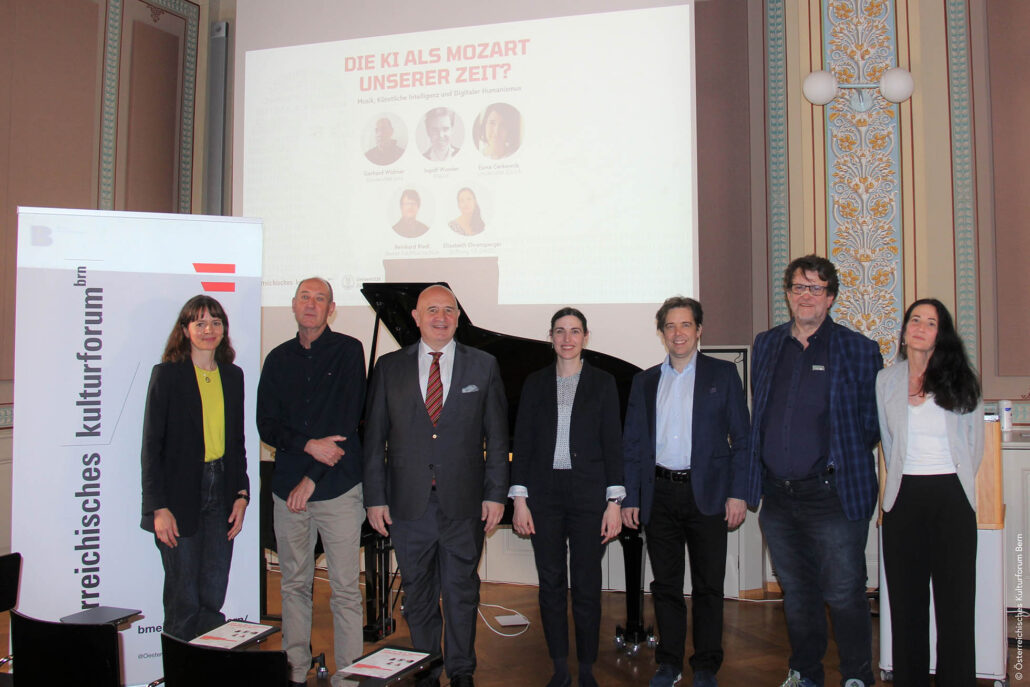

A report on the symposium «AI as the Mozart of Our Time?» on 24 April 2026 in the Kleine Aula of the University of Zurich – organised by the Austrian Cultural Forum, the University of Zurich, and Bern University of Applied Sciences
One AI event chases the next – and yet we know almost nothing about how AI is currently changing the world. Because the focus is almost always on potentials or risks. Practical changes are rarely a topic, and cultural processes hardly ever. And this despite the fact that cultural studies are currently publishing spectacular results and, together with data science, launching a pincer movement on the social sciences.
So we thought to ourselves: if no one is interested in the cultural processes of digital transformation, then let’s confront people with the cultural processes of high culture. The request from the Austrian Cultural Forum gave us the great opportunity of a joint implementation of this plan. What follows is an event report.
«No one can tell the difference between music composed or performed by AI and music composed or performed by humans. The bubble of elite music professionals fears that music will degenerate into a mere consumer good, but very few music consumers see a problem with that» – this was the conclusion of one audience member. She wasn’t entirely wrong.
When people talk about «AI in music», composition is usually at the centre of the discussion – just as in the analogue world: there, the music-making of orchestral musicians is a non-topic (unless they are being insulted, as recently in Venice), listening is almost entirely unimportant (after all, we already know what we are hearing), and criticism has been largely abolished.
Perhaps that is just as well, because the music critic in the audience failed until the very end of the symposium to grasp that the subject was musical interpretation and not musical composition. As a result, he complained bitterly that the panel had not been filled with composers – kindly only after the apéro, so as not to spoil the lively atmosphere.
In fact, however, the symposium «AI as the Mozart of Our Time?» did NOT aim at the well-trodden path of debates about AI music compositions. Instead, it was about listening and about interpreting music. These topics are addressed far less frequently in the public AI discourse, but they are highly topical in academic research.
Envoy Walter Gehr from the Austrian Ministry of Foreign Affairs opened the event by outlining the aesthetic dimensions of digital humanism and explaining why his ministry was supporting the event.
The pianist Ingolf Wunder then demonstrated what human musical interpretation sounds like, and described the dangers that the omnipresence of music brings with it: it makes us unlearn how to listen attentively and renders us indifferent to the difference between human expressive power and the mechanical playback of notes. For Wunder, AI is a tool for analysing and learning in music, but no substitute for human musicians, because it makes music in an artistically empty way and without intention. Indeed, many experts argue that so far it has not been possible to teach AI to imitate human musical interpretation at the highest level. In a private conversation, the pianist attributed this, among other things, to the limited quality of the digital recordings used to train AI.
Wunder moves between different worlds: classical music, AI development, and entrepreneurship. His great concern, however, is to give school music education greater significance again. After all, in Switzerland musical education is not a matter of voluntary cultural policy but a state responsibility (Article 67a of the Federal Constitution). True, there are occasional complaints that the bureaucratisation of music education is taking on bizarre forms, but for me this is above all yet another piece of evidence of the unchecked growth in state activities concerning the arts. In other areas, for example, people pride themselves on awarding project funding without even reading the applications, because supposedly they already know who can do what. In any case, the Austrian Wunder’s commitment fits Switzerland very well.
The computer scientist Gerhard Widmer then presented the current state of AI capabilities in musical interpretation in detail. AI has by now become so good at listening that page-turners are essentially no longer needed. Careers like that of the current director of the Zurich Opera House, Matthias Schulz, are therefore no longer possible. But it remains to be seen what the user experience with AI will be like. Some apps already offer this functionality, partly based on gestural control. In any case, AI can by now do more than just follow along with the score while listening.
It can, for example, also recognise and classify human emotions. And it manages quite well to play four-handed piano together with human pianists. In autonomously interpreting music, too, it has reached an impressive level of quality, even if it still cannot quite keep up with the very best. Widmer also demonstrated how difficult it is to distinguish human pianists from AI performers. Only for replacing music critics does it simply lack the ability to ignore information and to misunderstand things creatively. It lacks this precisely because it acts without intention. But this was not the subject of Widmer’s talk. He concluded with the statement: «Machines can learn to compose, produce, “interpret” music… but we don’t have to listen to them.»
The musicologist Esma Cerkovnik then gave a historical overview of mechanical thinking in music history, beginning with Jacques Vaucanson and Julien Offray de la Mettrie. The focus was on Mozart’s compositions for musical clocks – another but still little-known example of his musical genius, since they impressively highlight the characteristic properties of the playback instruments of the time. This inevitably raises the question of whether the disdain for mechanical music is not in fact an embarrassing form of snobbery. Do we really understand so much more about music than a Mozart – or even than a Jean Paul, who probably inspired Mozart to compose for musical clocks?
In general, Mozart remains a productive reference for innovations in music even today. Starting from Mozart’s engagement with the sonic properties of the playback instruments of his time, Cerkovnik showed that principles of post-medial conceptual art are entirely conceivable in the thoroughly medial context of music as well. So for once, the discussion that evening did circle back to composition – with AI not as a tool but as inspiration and subject matter, which in turn was a reminder that, as in so many other places, the boundaries between composition and interpretation are blurring here too.
As a side remark: Cerkovnik’s analysis recommends itself for a broader discussion at Zurich’s Sonic Matter Festival.
The closing panel discussion, which the deputy ambassador Franziska Pfeiffer and I moderated, addressed the question «Is AI a competitor or a complement to human musicians?» as well as the question of what is special about human music-making compared with the artificial music-making of human-developed AI. The statements from the talks were once again sharpened and brought to the point, and the different perspectives emerged very clearly – Wunder’s heartfelt mission of teaching, Widmer’s wonderfully free l’art pour l’art research, and Cerkovnik’s pursuit of insight and innovation rooted in current artistic developments.
Elisabeth Ehrensperger, Managing Director of TA-Swiss, rounded out the trio to a quartet. She presented the findings of a study conducted before the emergence of the new generative AI and made clear how disruptive this generative AI has proved to be since then. Once again, it became apparent that technology monitoring is a dynamic process in which topics cannot simply be dismissed with the remark that there was already a study on the matter three years ago.
The audience took an active part in the panel discussion. Among other things, a listener inspired by Widmer’s demonstration suggested that AI at its current level could be put to very good use in music education. And the discussion continued intensively at the apéro. Some misunderstandings could be cleared up, new ones arose. As cheerful and relaxed as this all unfolded, it left a strong impression on a number of listeners. Including later, at the after-gathering with friends.

Prof. Dr Reinhard Riedl is a lecturer at the Institute of Digital Technology Management at BFH Wirtschaft. He is involved in many organisations and is a member of the steering committee of TA-Swiss. He is also a board member of eJustice.ch, Praevenire - Verein zur Optimierung der solidarischen Gesundheitsversorgung (Austria) and All-acad.com, among others.
 Contributions as RSS
 Comments as RSS
Leave a Reply
Want to join the discussion?Feel free to contribute!