
Digital Nudges Against Food Waste: How an AI-Supported App Changes Behaviour
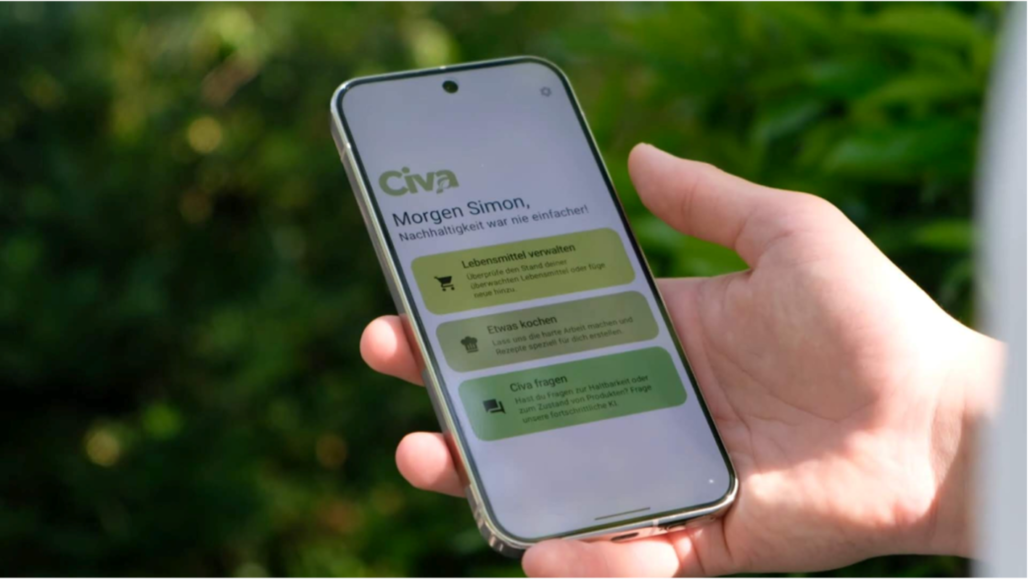

Around 60 percent of global food waste originates in private households – mostly through uncertainty about expiry dates and through everyday routines. As part of a project mentorship for “Schweizer Jugend forscht” (Swiss Youth in Science), the Civa app was used to test whether digital, AI-supported nudges can measurably change behaviour. The results show that they can – within clear limits.
A typical everyday scenario: in the fridge sits a yoghurt whose best-before date has passed. After brief hesitation, it is thrown away. Such micro-decisions add up daily to thousands of tons of food waste. The underlying problem is not a lack of knowledge but a discrepancy between attitude and behaviour: food waste arises primarily from uncertainty, routines and situational inattention – that is, from the conditions under which decisions are made.
In Switzerland, around 119 kilograms of avoidable food losses occur per person each year, the largest share of which originates in private households. Switzerland thereby falls short of the targets defined by the Federal Council (SRF, 2025). Globally, around 60 per cent of food waste originates in the home (UNEP, 2024). The central question is therefore not why this knowledge is missing, but why it fails to guide action at the moment of decision.
Digital Nudging in Everyday Life
Behavioural economics offers a well-established explanatory approach: nudges are small, targeted prompts that influence decisions without restricting freedom of choice (Thaler & Sunstein, 2008). Classical nudges are predominantly designed as analogue interventions – for instance through product placement, default settings or visual cues. Digital technologies extend this principle: they can be personalised, triggered situationally, dynamically adapted and further developed based on usage data. They can thus intervene precisely at the moment when the critical decision is made. What remains open, however, is whether such interventions are effective under real everyday conditions.
The Civa App as a Behavioural Intervention
The effectiveness of this approach was empirically investigated in the Civa app project (20 Minuten, 2025; Balmer, 2026; Schweizer Jugend forscht, 2026). The application does not intervene at the point of purchase but in the consumption phase – the part of the food chain in which most of the household waste occurs. It integrates five coordinated interventions: inventory transparency, expiry notifications, inventory-based recipe suggestions, context-related shelf-life assessments beyond the best-before date, and AI-supported decision-making in situations of uncertainty. These functions operate as digital nudges that structure the decision-making context in the household and reduce the likelihood of unintended food losses.
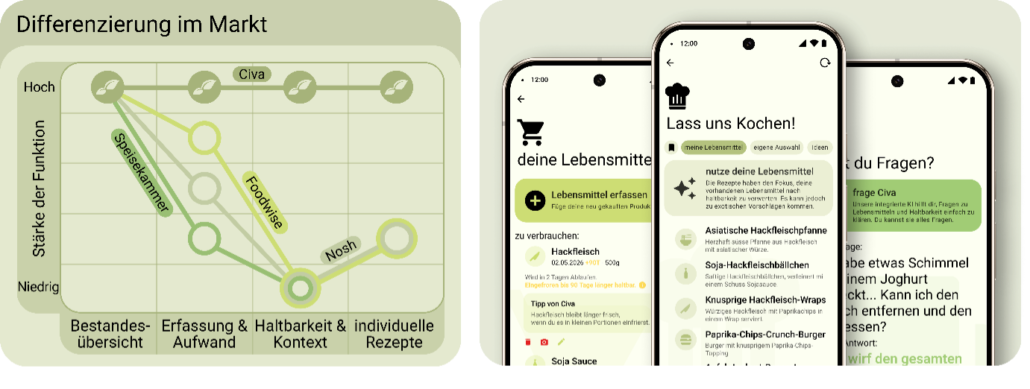
Within the existing market, this integrated approach is barely covered: available solutions are mostly limited to inventory lists or static recipe databases. The combination of shelf-life context, situational decision support and individual assistance at the moment of use is largely absent. Generative artificial intelligence (GenAI) substantially expands the possibilities, as it makes context-related and personalised interventions available precisely when they become relevant to decisions in everyday life.
Empirical Evaluation: Does Behaviour Actually Change?
Digital applications are frequently associated with behavioural change, yet empirical evidence remains scarce. The app was therefore systematically evaluated. The study design followed a multi-stage, quasi-experimental approach: households first documented their food waste without intervention (baseline measurement) and subsequently while using the app (intervention). An extended study additionally included a control group to account for external effects such as seasonal fluctuations or observation effects. The results show a consistent, quantifiable change in behaviour (Balmer, 2026):
- In the initial field study, documented food waste was reduced by around 45 percent.
- In the methodologically more rigorous follow-up study, a reduction of 21 percent within the intervention group was observed, while the control group showed an increase over the same period.
What matters here is not so much the absolute magnitude of the effects, but their robustness across different study designs. The results indicate that digital interventions can address not only attitudes but actual behaviour in everyday life.
Mechanism: Reducing Uncertainty
The analysis of the data allows for inferences about the underlying mechanisms. A considerable share of food waste arises because consumers misjudge whether products are still fit for consumption. The best-before date in particular is often interpreted as a safety threshold, although it primarily denotes a quality guarantee (Beretta et al., 2021). The intervention addresses this bottleneck through context-related shelf-life assessments, easily accessible additional information and immediate decision support in the context of use. This combination reduces subjective uncertainty, with the result that this specific cause of waste virtually disappears within the application.
At the same time, an important differentiation emerges: not all behavioural patterns respond equally to digital interventions. While uncertainty-driven decisions appear readily addressable, habitualised behaviours – particularly over-preparation when cooking – remain largely stable. Digital nudges are effective above all where decisions are situational, cognitively demanding and reversible, less so where deeply rooted routines dominate.
From Knowledge to Action
The obstacle to sustainable consumption lies not in a lack of knowledge but in its insufficient effectiveness at the actual moment of decision. Digital nudges address this gap by translating abstract knowledge into concrete situations of action in a context-dependent and personalised manner.
A key factor of effectiveness is the use of generative artificial intelligence – not as an end, but as part of the behavioural architecture. GenAI functions as a technological prerequisite for adaptive and context-sensitive interventions:
- It generates personalised suggestions for action in real time, for instance recipes based on existing inventory.
- It interprets contextual information, such as through image recognition of food items or the categorisation of shelf-life classes.
- It reduces cognitive complexity by structuring and simplifying decision-making processes.
The intervention thus addresses a central obstacle to sustainable behaviour: not a lack of motivation, but cognitive overload and decision effort. By lowering these cognitive costs, GenAI increases the likelihood that sustainable options will be chosen. In this sense, it functions not as a substitute for decision-making but as a behavioural amplifier that translates existing intentions into concrete actions.
The implications extend beyond the case of food waste. They concern fields of action in which sustainable behaviour fails at the level of everyday micro-decisions – such as energy consumption, mobility or health behaviour. Where digital systems can support decisions in context, the design lever shifts from the dissemination of knowledge to the level of behaviour.
References
20 Minuten (2025). Mit App gegen Food Waste: Luzerner Lernende gewinnen KI-Preis. https://www.20min.ch/story/lernekich-wettbewerb-mit-app-gegen-food-waste-luzerner-lernende-gewinnen-ki-preis-103361858
Balmer, S. (2026). Civa App Projekt | gegen Food Waste – Nutze, was du hast! https://civa-app.ch/
Beretta, C., Kremer-Hartmann, K., Spielmann-Prada, G., Züst, M., Gantenbein-Demarchi, C., Müller, C., & ZHAW Zürcher Hochschule für Angewandte Wissenschaften. (2021). Leitfaden zur Reduktion von Lebensmittelverlusten bei der Abgabe von Lebensmitteln: Rechtliche Aspekte und Lebensmittelsicherheit. https://www.blv.admin.ch/dam/blv/de/dokumente/lebensmittel-und-ernaehrung/lebensmittelsicherheit/leitfaden-reduktion-lebensmittelverlusten.pdf
Schweizer Jugend forscht (2026). Entwicklung und Erprobung einer digitalen Intervention gegen Food Waste im Haushalt. https://inspiration.sjf.ch/entwicklung-und-erprobung-einer-digitalen-intervention-gegen-food-waste-im-haushalt/
SRF (2025). Bilanz des Bundesrats: Food-Waste-Ziel bisher klar verfehlt – News – SRF
Thaler, R. H., & Sunstein, C. R. (2008). Nudge: Improving Decisions About Health, Wealth, and Happiness. Yale University Press, New Haven.
UNEP (2024). Food Waste Index Report 2024. United Nations Environment Programme. https://www.unep.org/resources/publication/food-waste-index-report-2024

Stefan Grösser is Professor of Decision Sciences and Policy and heads the Management Science, Innovation and Sustainability research group at BFH Technology & Informatics. He lectures in the Master of Engineering (MSE) program and works on several research projects in the fields of simulation methodology (system dynamics, agent-based modeling, machine learning), decision-making using artificial intelligence (decision-making and management science), and circular economy (circular economy, circular business models). His industries of focus are the solar, energy, and healthcare sectors. He also contributes to modern learning technologies.
 Simon Balmer completed an apprenticeship as a multimedia electronics technician (EFZ), followed by a technical vocational baccalaureate (BM TALS) at BBZB Lucerne. The project presented in this article was developed as part of Schweizer Jugend forscht under the supervision of Stefan Grösser. Further development of the project remains open; Balmer welcomes feedback, ideas and potential collaborations.
 Contributions as RSS
 Comments as RSS
Leave a Reply
Want to join the discussion?Feel free to contribute!