
Accessibility is not enough: digital services need a positive user experience


Since the end of June 2025, digital services in the EU have had to be accessible to people with disabilities. But accessible does not mean pleasant: checking accessibility against a checklist alone reveals nothing about the aesthetics, enjoyment and emotions involved in using a product. Why a user-centred approach has to bring accessibility and user experience together.
The growing relevance of accessibility
A large part of our lives now takes place online: buying a train ticket, booking a hotel, dealing with public authorities, managing our banking – all of these activities are almost impossible today without using technology. Yet these technologies are mostly developed exclusively for people who have no physical, sensory or cognitive impairments, and they are difficult or impossible for everyone else to use. In recent years, service providers and technology corporations have made considerable efforts to make software and technical devices usable for people with disabilities as well. This is what is referred to as accessibility. Laws and regulations have been adapted too. The EU directive known as the European Accessibility Act (EAA) was adopted in April 2019 and is effective since the end of June 2025. It obliges providers of certain products and services – online shops, banking services, ticketing and others – to make them accessible to people with disabilities (Directive 2019/882 on the accessibility requirements for products and services). In Switzerland, the Federal Act on the Elimination of Discrimination against People with Disabilities (BehiG) has so far applied primarily to the public sector; a partial revision intended to cover private providers of digital services as well is currently going through parliament.
Three terms that are often conflated
Before we turn to the core argument, three distinctions:
- Accessibility refers to the extent to which a product can be used by people with the widest possible range of abilities.
- Usability describes how effectively, efficiently and satisfactorily a product can be operated.
- User experience (UX) goes further and covers everything users perceive and feel before, during and after use, such as aesthetics, emotions, trust.
Accessibility today – yes, but often without a positive user experience
The development and enforcement of the new EAA directive are highly welcome in the interest of comprehensive accessibility for all – but in our view they are not sufficient. In our theoretical paper (Sauer, Sonderegger & Schmutz, 2020), we explain why technology should not only be accessible, that is to say usable, for people with disabilities, but why using it should also be enjoyable and evoke positive emotions. To illustrate this issue, it is worth looking briefly at how technology has developed in the past and at the concepts of usability and user experience (UX).
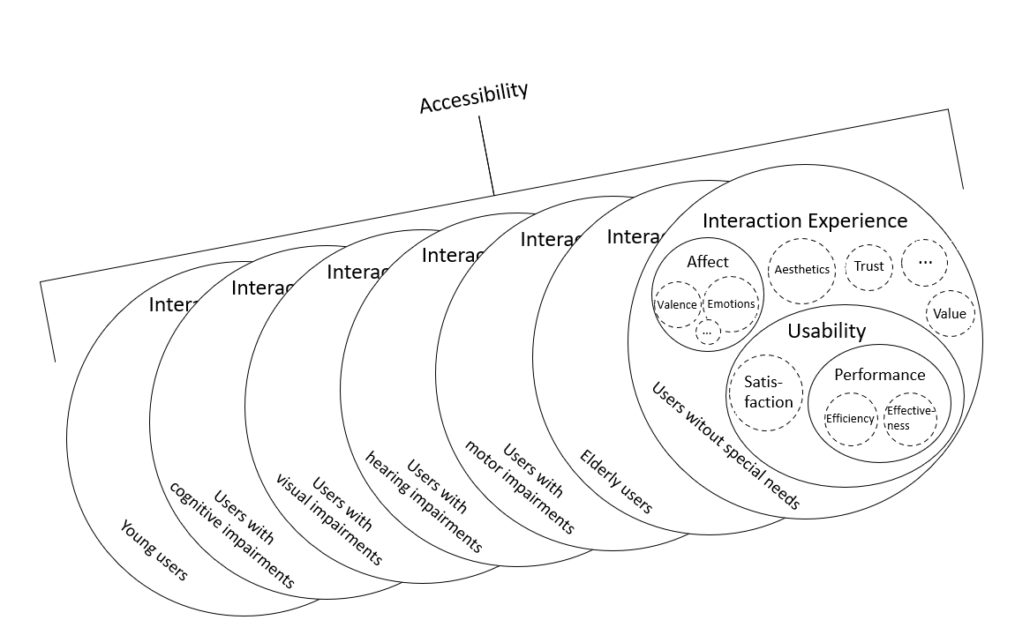
IX Modell (Sauer, Sonderegger & Schmutz, 2020)
When the first PCs were introduced in workplaces in the 1970s and 1980s, it was important for their use that they could be operated efficiently, successfully and satisfactorily. These requirements for technical systems are summarised under the term usability. For a long time, the development of technological systems focused primarily on usability. With the widespread emergence of consumer electronics such as MP3 players, mobile phones and video recorders, however, developers increasingly came to understand that technology should not only be efficient, successful and satisfying to operate, but that using it should also bring enjoyment and pleasure – in other words, a positive user experience. Aspects such as design aesthetics, enjoyment and positive emotions, as well as a sense of prestige, became increasingly important in the course of this development.
Today, accessibility primarily means that technology is usable for people with disabilities in the sense of usability. We argue for going beyond this minimum objective and placing a stronger focus on the user experience of people with disabilities – developing technology in such a way that using it is accompanied by pleasure, aesthetics and positive emotions for everyone.
Enjoyment and aesthetics as the next step for accessibility
To achieve this goal, it is essential to reinterpret the user-centred approach to developing technology. Considerable attention is already paid today to capturing user experience when designing digital solutions. This usually involves user tests in which prototypes of a new technology are tested with prospective users. Such tests measure not only whether people are able to operate the product; they also assess emotions, aesthetics, enjoyment and the experience of prestige – information that is then used to improve the product further.
To ensure accessibility, by contrast, guidelines and checklists are usually applied (for example the WCAG guidelines of the World Wide Web Consortium, Kirkpatrick et al., 2018). These conformity checks are valuable, but they pursue a different aim: they test technical requirements, not experience. In most cases this does enable people with disabilities to use a product – but it allows no conclusions about the aesthetic experience, the enjoyment and the emotions that accompany its use.
If we want to design technology whose use is accompanied by pleasure and aesthetics for everyone, user experience must therefore also be tested with, and taken into account for, people with disabilities during product development. Only in this way can we ensure that we take the step from accessibility to user experience for all.
References
- Directive 2019/882. The accessibility requirments for products and services. European Parlliament, Council or the European Union. https://eur-lex.europa.eu/legal-content/EN/TXT/?uri=CELEX%3A32019L0882
- (2026). Individuals – frequency of internet use (isoc_ci_ifp_fu). European Commission. https://ec.europa.eu/eurostat/databrowser/view/isoc_ci_ifp_fu__custom_11247891/bookmark/table?lang=en&bookmarkId=095f80ac-7b3d-4757-a0bc-4090eb046290&c=1715083227214
- Kirkpatrick, A., O’Connor, J., Campbell, A., & Cooper, M. (2018, 5 juin). Web Content Accessibility Guidelines (WCAG) 2.1. World Wide Web Consortium (W3C). https://www.w3.org/TR/WCAG21/
- Sauer, J., Sonderegger, A., & Schmutz, S. (2020). Usability, user experience and accessibility: towards an integrative model. Ergonomics, 63(10), 1207-1220.

Andreas Sonderegger is a professor at the Bern University of Applied Sciences in Economics and a lecturer at the University of Fribourg. He researches and teaches in the fields of cognitive ergonomics, human-computer interaction and work and organisational psychology. He is the founder and owner of Youser GmbH, an agency specialising in UX evaluation and design. Before joining BFH, Andreas completed his doctorate at the University of Fribourg, worked in various positions in the field of human resources and was 'Head of UX Research' at the EPFL+ECAL Lab.
 Sharon Guardini is a lecturer at the University of Fribourg. She holds a Master's degree with a specialization in Cognitive Neuroscience. During her studies, she completed an internship at the Bern University of Applied Sciences (BFH), where she worked on the effects of neurofeedback on tinnitus. Her research interests include user experience (UX), accessibility, and inclusive design, with a particular focus on creating universally pleasant digital interactions.
(Photo: STEMUTZ.COM)



 Contributions as RSS
 Comments as RSS
Leave a Reply
Want to join the discussion?Feel free to contribute!