
How copyright shapes which art we see online


Museums are digitising their collections and putting images online. Whether this pays off depends in part on copyright. A study by BFH, WIPO and the University of Illinois shows that more images of public domain artworks are available online and that museums display them in higher resolution. On average, an art image also appears on 76 other websites worldwide.
Digitisation costs money, visibility pays off
For a museum, digitisation is an investment. Works have to be photographed, catalogued and put online. Many museums are publicly funded and have tight budgets. These investments are offset by a clear benefit. Online collections fulfil the mandate to preserve cultural heritage and make it accessible. They raise an institution’s profile, can attract new visitors to the museum and can generate revenue, for example from image licensing.
For works that are still protected by copyright, further costs arise. First, the museum has to establish in advance who holds the rights and, where necessary, obtain licences. This rights clearance ties up staff and time, regardless of whether a licence turns out to be required. Second, a liability risk remains: misjudgements during rights clearance can lead to cease-and-desist letters and claims for damages, causing museums additional costs. The total costs can therefore weaken the incentives to digitise. In our study, we therefore examine how the legal status of an artwork affects whether and in what quality it is available online, and how often it is reused by online users (Sahli, Cuntz & Heald, 2026).
Similar works, different protection
In 1998, the United States retroactively extended the copyright term for many works from 75 to 95 years. This created a kind of natural experiment. Works created shortly before a certain year now tend to be in the public domain and may therefore be used freely by museums. Comparable works created only a few years later tend to be still protected, and their use is therefore usually subject to licensing and fees. We compare these two groups for works held by US museums. As an additional comparison, we draw on works from European museums, to which the amended US rules do not apply.
To measure availability, we use data from the online platform Useum, which collects digitised images of more than 130,000 artworks from museums, Wikimedia and online users. We examine around 5,200 works by 1,334 artists, created between 1910 and 1940 and belonging to the collections of museums in the United States and in 22 European countries. For online reuse, we compiled a second dataset. Using Google’s image search, we recorded on which other websites the digitised works from US museums appear and in what resolution they are provided there. This resulted in a dataset of around 88,000 reuses of the works.
Public domain works are more often available online and in higher resolution
- Significantly more images of public domain works are available on Useum than of comparable, protected works by the same artists. Per year of creation, there is roughly one additional image for every two artists.
- Museums put their public domain works online in significantly higher resolution.
- Public domain images tend to be reused more frequently on the internet. However, this difference is less pronounced statistically.
Figure 1 shows the works from US museums by year of creation. For works that tend to be still protected, statistically significantly fewer images are available online.
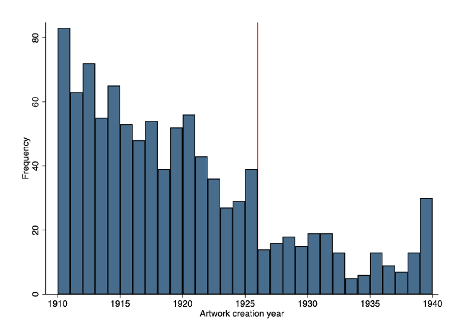
Figure 1: Number of digitised works from US museums on Useum by year of creation. Following the US reforms, works to the left of the red line tend to be in the public domain, while works to the right of it tend to be protected. Source: Sahli, Cuntz & Heald (2026), CC BY 4.0.
One image, 76 websites
Once an art image has been digitised and put online, it spreads rapidly. On average, the same image appears not only on the museum’s online portal but also on 76 other websites, reaching users far beyond the United States. More than half of these reuses take place on commercial sites, such as stock image agencies, poster shops and online marketplaces like Etsy or Amazon. The images also appear on Pinterest, Wikimedia and Google Arts & Culture. Digitised museum images thus become accessible to a wider audience and contribute to education, culture and the economy on a scale that goes far beyond the individual museum.
Clear industry rules facilitate access
US museums also put protected works online. In doing so, they rely on the “fair use” provisions of US law, which permit certain uses without the prior consent of the rights holder, for example for educational purposes. In its guidelines, the Association of Art Museum Directors recommends small thumbnail images with a limited number of pixels for this purpose. Figure 2 shows that museums mostly follow this recommendation (blue circles). They show images of public domain works at both low and high pixel counts. For protected works, by contrast, museums almost exclusively show images with low pixel counts. Websites run by other operators (grey crosses), such as commercial providers, do not show this pattern. The fair use rules thus reduce the costs and risks of rights clearance and ultimately make more art accessible on the internet. The art market also shows how important legal certainty is for market participants and users of works. After a US court made the limits of fair use in appropriation art less certain in 2013, thereby increasing the liability risk for sellers of such works, auctions of these works temporarily declined (Cuntz & Sahli, 2024).
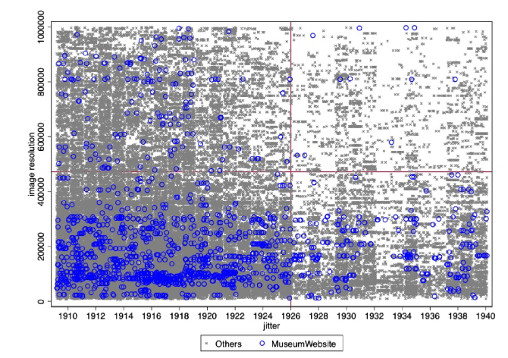
Figure 2: Image resolution (width times height in pixels) of art images online by the work’s year of creation. Blue circles represent images on museum websites; grey crosses represent images made available on other websites. The horizontal line separates images with a low pixel count from images with a high pixel count according to the guidelines. Following the US reforms, works to the left of the vertical line tend to be in the public domain, while works to the right of it tend to be protected. Source: Sahli, Cuntz & Heald (2026), CC BY 4.0.
The link to artificial intelligence
With generative AI, these questions are gaining in importance. AI models for images learn from large quantities of freely available images. Which works are online, and in what quality, therefore also shapes what AI is trained on. Museums are thus becoming important suppliers of training data. How copyright should balance access to cultural heritage against incentives for artists in this context is being debated in many countries. Our findings provide an empirical basis for this debate.
Conclusion
The legal framework influences whether digitising art pays off for museums. Public domain works are more often available online, usually in higher resolution, and are used on the internet worldwide. Similar findings already exist for books (Heald, 2014). Clear industry rules help museums make protected works accessible as well. This is relevant for policymakers when deciding on copyright terms, copyright exceptions and the handling of AI training data.
The views expressed are those of the authors and do not necessarily reflect the official position of WIPO or its member states.
References
Cuntz, A. & Sahli, M. (2024). Intermediary liability and trade in follow-on innovation. Journal of Cultural Economics, 48(1), 1–42. https://doi.org/10.1007/s10824-023-09470-1
Heald, P. J. (2014). How Copyright Keeps Works Disappeared. Journal of Empirical Legal Studies, 11(4), 829–866. https://doi.org/10.1111/jels.12057
Sahli, M., Cuntz, A. & Heald, P. J. (2026). Digital reuse and online availability of visual artworks. Information Economics and Policy, 73, 101172. https://doi.org/10.1016/j.infoecopol.2026.101172

Matthias Sahli is a Senior Researcher at the Institute for Public Sector Transformation at BFH Business School. His research focuses on intellectual property, digital sustainability and cultural economics. He previously worked at the World Intellectual Property Organization (WIPO) in Geneva and at the Swiss Federal Institute of Intellectual Property (IPI). He holds a doctorate in economics from the University of Neuchâtel.
 Alexander Cuntz heads the Creative Economy Section of the World Intellectual Property Organization (WIPO) in Geneva. WIPO is a specialised agency of the United Nations dealing with patents, trademarks and copyright worldwide. Alexander Cuntz conducts empirical research on innovation, creativity and intellectual property, and on the consequences of new technologies for the creative economy. He previously worked as a Senior Researcher and policy adviser at the Commission of Experts for Research and Innovation (EFI) in Germany and at the European Commission.
 Paul J. Heald is Professor Emeritus at the University of Illinois College of Law (Albert J. Harno and Edward W. Cleary Chair in Law Emeritus). He previously taught at the University of Georgia for 22 years. He conducts empirical research on copyright and patent law, in particular on how copyright terms affect the availability of books, music and images. He is also an Honorary Professor at the CREATe Centre at the University of Glasgow.
 Contributions as RSS
 Comments as RSS

Leave a Reply
Want to join the discussion?Feel free to contribute!