
Detecting stress without adding to nurses’ workload
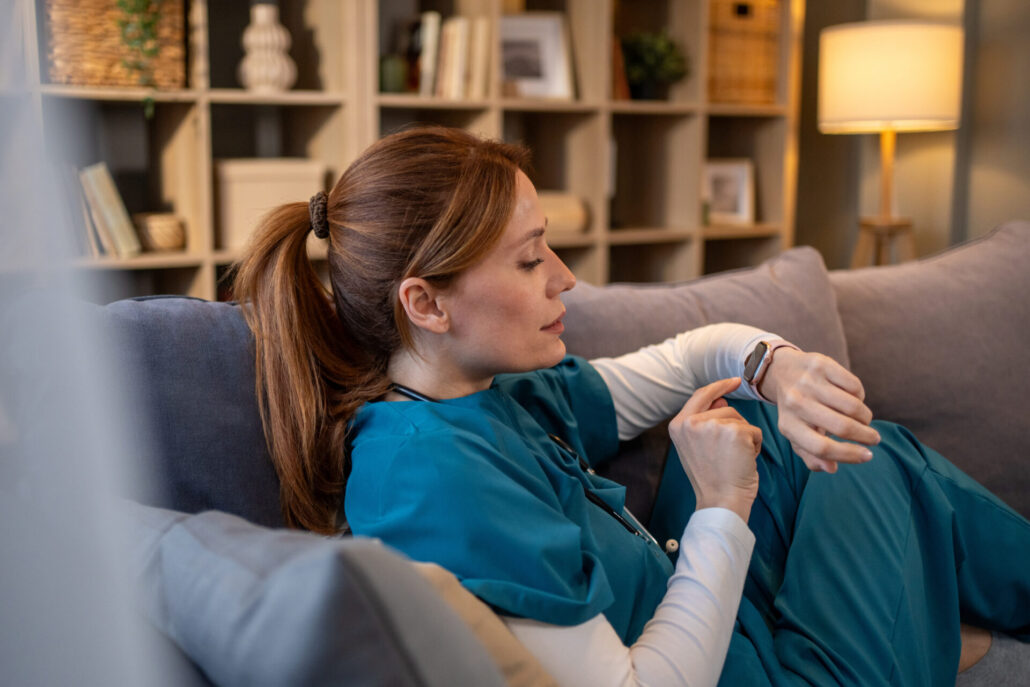

Work-related stress can affect nurses’ health, their ability to work and whether they remain in the profession. Conventional surveys, however, often reveal strain only at a late stage. A BFH project is therefore investigating whether smartwatch, shift-schedule and routine data can make stress in everyday nursing visible early and with as little additional burden as possible.
When measuring stress becomes a burden
High work demands, difficulties in balancing work and private life, and a lack of opportunities for recovery shape the working day of many nurses. Work-related stress is not only relevant to employees’ health. In the long term, it can also be associated with burnout, reduced work ability and the intention to leave the profession. Stress therefore also becomes a question of securing healthcare provision in the long run.
Healthcare organisations currently often assess such strain by means of surveys. These provide important information but have their limits: they take time, place an additional demand on employees and often capture only a single point in time. At the same time, willingness to take part in surveys is declining. Short-term changes between individual working days or shifts are therefore difficult to detect.
This is where the interdisciplinary BFH project “Technological detection of work-related stress among nurses” came in. Researchers from the School of Health Professions and the School of Engineering and Computer Science investigated whether existing, automatically collected data could be used to capture strain as closely as possible to everyday working life.
Stress is more than a high pulse
A key challenge is first of all the question of what should be measured at all. Stress is not a single value. A demanding shift schedule, a high workload or having to cover a shift at short notice can all be stressors. How strongly a person reacts to them, however, depends on factors such as individual resources, the situation and the available opportunities for recovery.
An elevated pulse is therefore not in itself a clear stress signal. It can just as well result from physical activity, such as climbing stairs or walking quickly. Physiological signals must be interpreted in the context of work. This is precisely the advantage of an approach that combines different data sources.
Four perspectives on the same working day
24 nurses from two healthcare organisations took part in a three-month feasibility study. Four different types of information were collected:
- Physiological data via a smartwatch, for example on heart rate.
- Shift-schedule data reflecting working hours and shift patterns.
- Texts from routine nursing documentation written by the participating nurses themselves.
- Brief daily self-assessments, which served as a reference value for subjectively experienced stress.
The data were thus largely generated where stress actually occurs: in real everyday nursing practice rather than in an artificial laboratory setting.
The daily self-assessment was necessary in order to compare the technologically collected data with the nurses’ personal experience. Only then is it possible to examine which patterns are actually associated with perceived stress.
The shift schedule provides a surprising amount of context
The results show why these different perspectives matter. The information from the shift schedules proved particularly revealing. For example, perceived strain differed depending on the type of shift. Changes to the originally planned shift or being called in on a day off can also indicate an impaired balance between work and private life.
The technical analyses also yielded promising results. Physiological and text-based data contained information about stress, yet none of the sources could capture the full picture on its own. Context became particularly relevant when additional information on the respective shift and work situation was taken into account. Above all, the preliminary work thus shows one thing: what matters is not the amount of data, but the meaningful combination of different data sources.
Technically feasible does not yet mean fit for practice
The question, however, is not only whether stress can be detected technologically. How such methods are used is equally important.
Data on heart rate, working hours or the use of digital systems can quickly create the impression of permanent surveillance. In the feasibility study, therefore, only the researchers had access to the anonymised data. The high willingness to participate shows that nurses are not fundamentally opposed to such approaches. What is decisive, however, is transparency, data protection and a clearly recognisable benefit.
Future stress monitoring should therefore not answer the question: “Which nurse is particularly stressed?” A far more relevant question is: “Which working conditions repeatedly lead to strain, and where can an organisation take action?” This shifts the focus from monitoring individuals towards prevention and the design of healthy working conditions.
From proof of concept to stress monitoring
The study shows that technology-supported assessment of work-related stress in real everyday nursing practice is possible in principle. At the same time, it makes clear where further research is needed. The sample was small, the observation period limited, and individual stress signals cannot yet be interpreted unambiguously. The results are therefore not a ready-to-use instrument for healthcare organisations, but a proof of concept and a starting point for the next phase of research.
In a planned follow-up project, the approach is to be examined with more healthcare staff, over a longer period and with additional data sources. The long-term aim is to make changes in working conditions visible at an earlier stage. Healthcare organisations could then identify situations of strain before they result in health consequences or people leaving the profession.
References
- Aebi, C., Grataloup, A., Ben Souissi, S. & Golz, C. (2026). Towards Realistic Privacy-Preserving Stress Detection for Nurses Using Smartwatch Data. In Proceedings of the 15th International Conference on Data Science, Technology and Applications – Volume 1: DATA; ISBN 978-989-758-854-9; ISSN 2184-285X, SciTePress, pages 317-324. DOI: 5220/0014980800004091
- Pareja Bernal, L. F., Ben Souissi, S., & Golz, C. (2026). Machine Learning–Based Detection of Workplace Stress Using Wearable and Multimodal Data: A Systematic Literature Review. Frontiers in Artificial Intelligence, 9, 1837195. https://doi.org/10.3389/frai.2026.1837195
- Ikae, C., Ben Souissi, S., Bieri, J.S. Müller, T.J., Feuz-Schlunegger, M., Golz, C. (2026). A scoping review of natural language processing for detecting work-related stress among health professionals. Discov Computing 29, 14. https://doi.org/10.1007/s10791-025-09886-7
- Bieri, J. S., Ikae, C., Ben Souissi, S., Müller, T. J., Schlunegger, M. C., & Golz, C. (2024). Natural Language Processing for Work-Related Stress Detection Among Health Professionals: Protocol for a Scoping Review. In JMIR Research Protocols (Vol. 13). JMIR Publications. https://doi.org/2196/56267

Christoph Golz is Head of Healthcare Innovation Field - Human Resources Development at the Bern University of Applied Sciences Health. His research focuses on the future-oriented and demand-driven development of health care.
 Souhir Ben Souissi
Dr Souhir Ben Souissi is a Tenure Track Professor of Data Engineering at the Institute for Data Applications and Security (IDAS) at the Bern University of Applied Sciences. Her research focuses, among other things, on the topicsof Medical Decision Systems, Semantic Web Technologies and Multi Criteria Decision System.


 Contributions as RSS
 Comments as RSS
Leave a Reply
Want to join the discussion?Feel free to contribute!