
Before the first model: How a challenge brief gets AI initiatives ready


What makes an AI initiative ready to move forward? Researchers from Bern University of Applied Sciences, the University of Liechtenstein and the University of St.Gallen examined AI Innovation Challenge Briefs from corporate innovation initiatives. Our findings show how this seemingly simple artefact can align business, design and technology – without requiring every uncertainty to be resolved first.
The problem before the project
Consider a familiar situation: an organisation wants to use AI to improve its customer service. The business unit hopes to reduce response times, IT is already considering a chatbot, and the data team points out that the necessary customer conversations may not be accessible. Service employees, meanwhile, may see an entirely different problem in their daily work. Before a single model is built, the initiative is already moving in several directions.
This is a central challenge in AI innovation: the problem, the intended value and technical feasibility cannot be clarified independently. What is possible depends on the available data, the task AI is expected to perform, and how reliable its outputs need to be – conditions that are often uncertain at the start and only become clearer through exploration (Lin & Maruping, 2025; Berente et al., 2021).
Design Thinking has been recognized as a method for addressing common challenges in AI innovation projects, helping teams bring user needs, organisational value and technical possibilities into the same process (Staub et al., 2023). But that leaves a practical question: how do you formulate a starting point that gives an interdisciplinary team direction without prescribing the solution too early?
A shared starting point for AI innovation
The AI Innovation Challenge Brief is a structured but adaptable description of the problem an innovation team wants to explore. Unlike a conventional project mandate, it does not define requirements for a predetermined solution – it creates a shared frame within which business, design and technology experts can investigate whether and how AI might create value.
Our research draws on the same underlying dataset – briefs from 42 corporate AI innovation initiatives, including 13 successive versions across five of them – but asks two different questions of it: what recurring elements make a brief work, and how do briefs change as teams move toward readiness? This work is part of Design Thinking for AI (DT4AI), an Erasmus+- and Movetia-supported initiative developing methods and learning resources for human-centred AI innovation.
What a brief needs
Our analysis identified seven recurring elements (Röckel et al., 2026). Four provide a stable frame: a verb that sets the direction, the object of innovation, the target group and the organisational context. Together, they answer four basic questions: What are we trying to change? What are we working on? For whom? In what setting?
Three further elements stay deliberately adaptable: internal data or resources, the technology under consideration, and the potential opportunities and risks. This flexibility matters because AI is an evolving design material whose capabilities and outputs are hard to fully anticipate in advance.
Combined, the seven elements form a practical starting point:
How might we [verb] [object of innovation], using [internal data or resources] and leveraging [technology], for [target group], considering [context] and conditioned by [opportunities and risks]?
This isn’t a sentence to complete mechanically – it is a tool for exposing gaps. If the target group stays vague, more user research may be needed. If “using AI” is the only technology statement, the actual task may still be unclear. If data is mentioned but its accessibility is unknown, feasibility remains an assumption rather than a fact. Keeping parts open also guards against committing too early to a solution – starting with a predetermined AI approach can shift attention toward demonstrating technical capability rather than understanding the problem (Davenport & Ronanki, 2018).
The wording of the object of innovation itself steers exploration: a modular object like “customer journey” invites teams to examine individual steps, while an innovation space like “Green IT initiative” leaves the outcome open – often creating more room for radical ideas.
How a brief becomes ready
A well-structured brief is a starting point, not proof that an initiative is ready to proceed. Tracking how briefs changed across their successive versions revealed three recurring phases (Hehn et al., 2026).
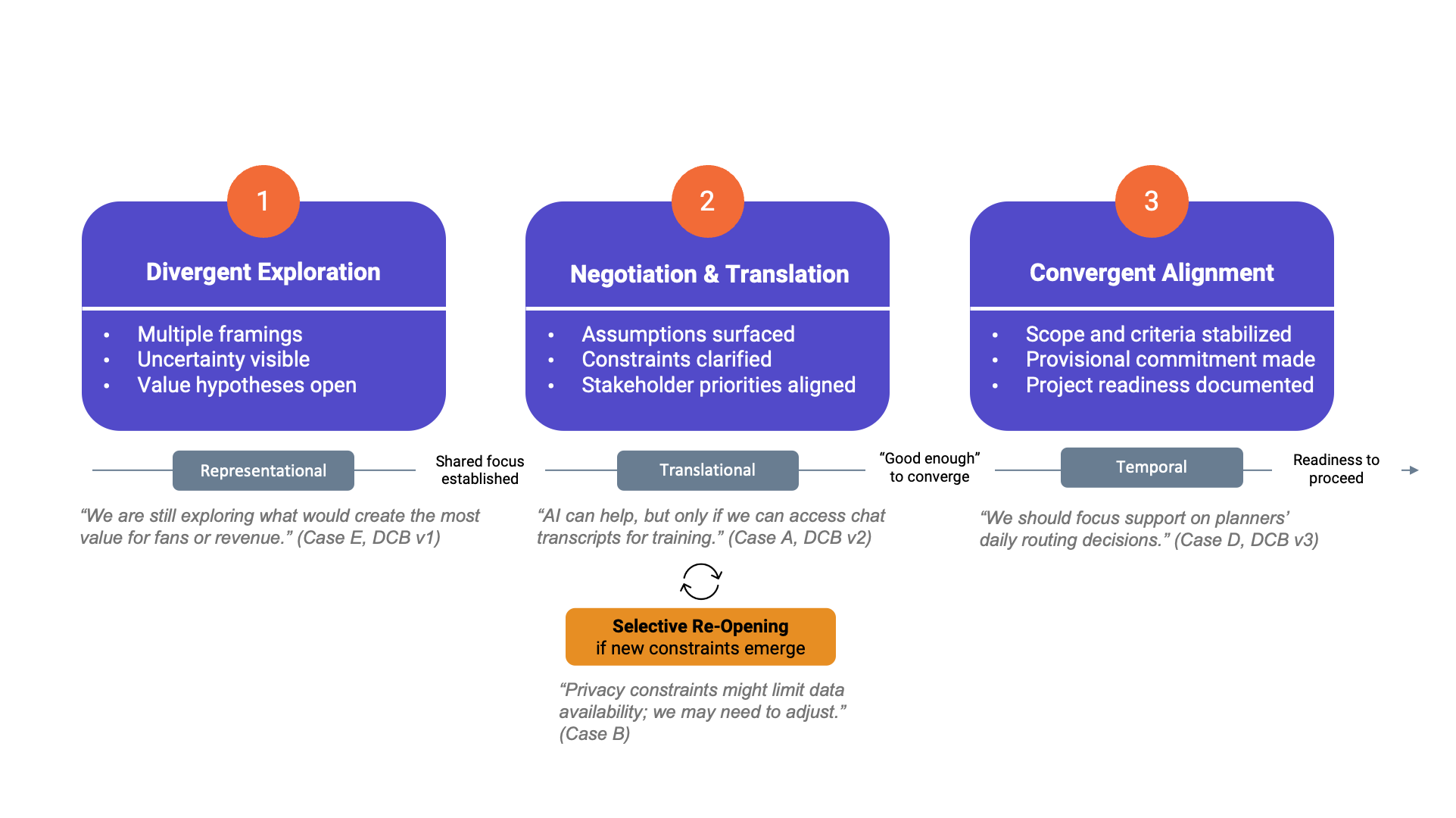
Figure 1: How the AI Innovation Challenge Brief develops from divergent exploration through negotiation and translation to “good-enough” alignment. Previously stabilised assumptions can be selectively reopened when new constraints emerge. Source: Hehn et al. (2026).
During divergent exploration, the brief keeps alternatives and uncertainties visible – teams may still be comparing value propositions, user groups, or possible applications of AI. In the negotiation and translation phase, assumptions become explicit: business ambitions meet user needs, data access, technical feasibility and criteria for evaluating AI outputs. During convergent alignment, exploratory language gives way to a specific intention – in one case, a broad discussion of predictive technologies narrowed into a focus on supporting planners’ daily routing decisions.
The progression is not strictly linear. When new information challenges a previously stabilised assumption – in one case, customer data assumed available turned out to be inaccessible – teams can selectively revisit that issue without reopening the whole brief. We call this selective reopening: not a fourth phase, but a feedback mechanism that keeps the brief adaptable while preserving progress already made.
Readiness is not certainty
Readiness does not mean eliminating every uncertainty. It is a provisional but actionable state: the team has clarified the task, documented the remaining risks, and reached sufficient alignment to justify the next investment. The brief performs two functions at once: it coordinates different perspectives by giving the team a shared point of reference, and it acts as a gate, recording why an initiative is (or is not yet) ready to move into design and modelling.
For organisations, the message is straightforward: don’t treat the challenge brief as a form filled out once at kickoff. It is a living coordination and readiness tool that should be revisited as the initiative develops. Before moving forward, decision-makers should be able to answer:
- Is the intended user and the task to be supported clear?
- Are data availability and access documented as facts or labelled as assumptions?
- Have business value, user value and technical feasibility been considered together?
- Are the remaining uncertainties explicit, and has the team agreed which ones are acceptable for now?
- Does the current wording express a shared direction rather than a collection of possibilities?
The goal is not a perfect consensus or a risk-free plan. It is a problem framing that is stable enough to guide action and flexible enough to accommodate learning. Long before the first model is trained, that balance may be one of the strongest indicators that an AI initiative is ready to become a project.
References
Berente, N., Gu, B., Recker, J., & Santhanam, R. (2021). Managing Artificial Intelligence. MIS Quarterly, 45(3), 1433-1450.
Davenport, T. H., & Ronanki, R. (2018). Artificial Intelligence for the Real World. Harvard Business Review, 96(1), 108-116.
Hehn, J., Röckel, F. A., & van Giffen, B. (2026). Structuring Readiness for AI Innovation: The Role of the Design Challenge Brief as a Coordination and Gatekeeping Artefact. ECIS 2026 Proceedings
Lin, Y.-K., & Maruping, L. M. (2025). Organizing for AI Innovation: Insights from an Empirical Exploration of U.S. Patents. MIS Quarterly, 49(3), 1095-1122.
Röckel, F. A., van Giffen, B., Janson, A., & Hehn, J. (2026). The Anatomy of a Design Challenge for Initiating AI Innovation. ECIS 2026 Proceedings
Staub, L., van Giffen, B., Hehn, J., & Sturm, S. (2023). Design Thinking for Artificial Intelligence: How Design Thinking Can Help Organizations to Address Common AI Project Challenges. In HCI International 2023 – Late Breaking Papers. Springer.
Further reading and listening
- Design Thinking for AI (DT4AI) – official BFH project page.
- Design Thinking for AI: Developing the right AI innovations – BFH background article in German
- AIS Insights podcast: The Anatomy of a Design Challenge – audio summary of the research and its implications
- AIS Insights podcast: Readiness for AI Innovation – additional audio introduction to the research and its implications

Jennifer Hehn is a professor and deputy head at the Institute for Digital Technology Management (IDTM) at Bern University of Applied Sciences. Her areas of expertise include Design Thinking, organisational foresight, and the human-centred capabilities organisations need to make AI-driven innovation work. Jennifer's research focuses on how organisations build the methods and skills that let AI-driven innovation succeed – before, during, and after the technology decision is made.
 Contributions as RSS
 Comments as RSS
Leave a Reply
Want to join the discussion?Feel free to contribute!