
The cooling capacity of trees: from measurement to digital twin
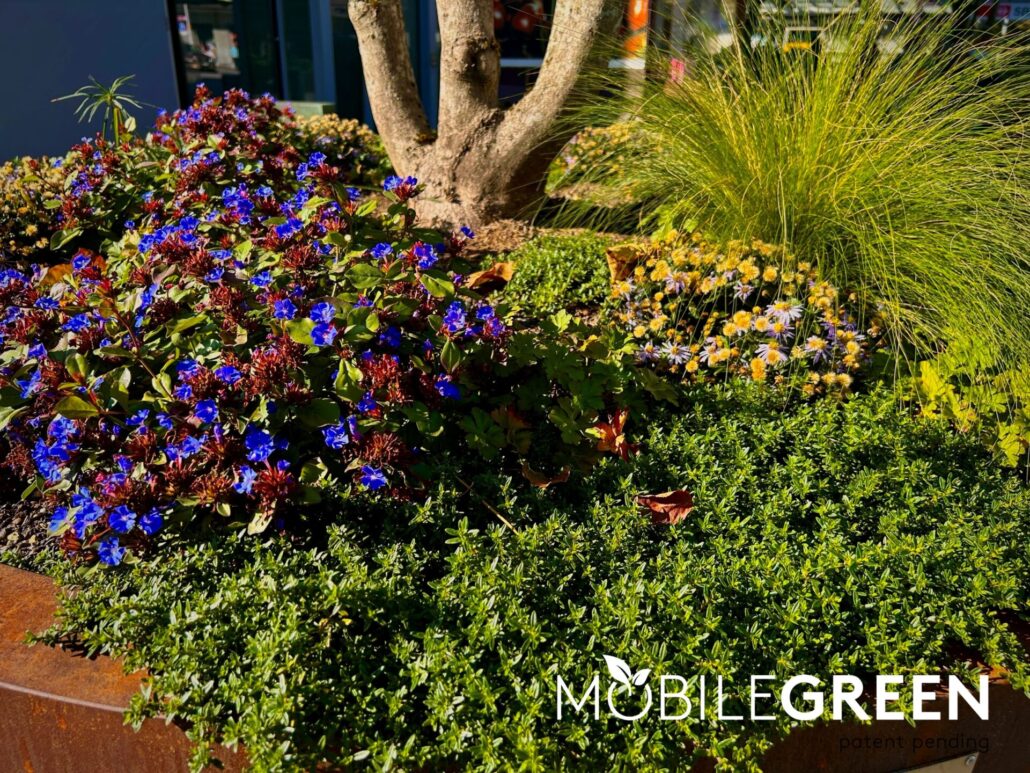

On hot summer days, temperatures on sealed surfaces climb above 40 °C. In the shade of a tree, the perceived temperature is 13 to 19 °C lower. The “Mobile Urban Green” project has made this cooling capacity calculable – for individual trees as well as for entire squares. In future, greenery can thus be integrated into planning as a digital twin.
The research project Mobile Urban Green aims to calculate the cooling capacity of mobile and permanently planted trees and to examine how such placements influence the way people use the sites where they are installed. This was achieved, on the one hand, by developing several mathematical models that calculate the cooling effect per tree and for entire areas and, on the other, through observations and surveys at the sites, which showed very high acceptance of the mobile greenery. As a result, our implementation partner can offer cities, municipalities and private clients precise planning as a consulting service, representing the planting as a digital twin during the project planning phase.

Figure 1: Thermal camera image of canopy cooling in Reinach
The starting point: trees in planters
The project’s starting point is Mobile Green, a complete solution comprising large potted trees from Bauerbaumschulen AG. The large planters provide good conditions for trees with substantial shading and evapotranspiration capacity to be used flexibly in public and private settings – in places where the ground (utility lines, underground car parks) would not otherwise allow planting, or where quick tests are needed but planning cycles are slow.
Measuring, calculating, applying
The project involves the BFH departments of Architecture, Wood and Civil Engineering (AHB), the School of Agricultural, Forest and Food Sciences (HAFL) and Social Work (S), which work together across disciplines. A central square in Solothurn, the forecourt of the municipal building in Reinach and the station forecourt in Wohlen (Canton of Aargau) were chosen as study sites in order to cover different spatial typologies and examine their respective influence. To cover these sites, 13 sets of measuring equipment with sensors, transmitters, solar cells and batteries were built.
Using the Burano method, walking routes and patterns as well as dwell times in the public spaces were studied. This showed that dwell times increase significantly and that neighbouring restaurants and shops also benefit from the trees.
The measurement data were used to simulate 1,440 cases on a high-performance computer, and the models were shown to have an accuracy of 99%. In addition, based on a sensitivity analysis, the models were simplified to the point that they run on standard laptops.
“What really impressed me was the enormous cooling capacity of the trees. Even on a hot summer’s day, the perceived temperature in the shade of a tree drops by 13 to 19 °C. Temperatures on sealed surfaces, by contrast, can climb to well over 40 °C.”
Hosting was set up so that the implementation partner can integrate the models into its IT infrastructure, and a user interface was built so that it can operate them easily. In addition, potential customers were segmented for a business case and interest in purchasing the consulting service was explored. Finally, the implementation partner optimised the underplanting, thereby increasing biodiversity and reducing littering.
From feasibility study to Innosuisse project
After entering into discussions with the implementation partner, we were very quickly able to build a first prototype for measuring physiologically perceived temperatures. These measurements took place at Messeplatz Basel in midsummer 2023. They showed that we could obtain relevant measurements, but that the equipment was not yet vandal-proof.
As a next step, we applied for internal BFH funding through an HDT voucher, which we were granted. With this budget, we were able to take the data analysis of the prototype further, advance the concept and design of the measuring equipment and plan a vandal-proof implementation. For us, this was an important bridge to the next step: drafting an Innosuisse application.
“The project focused less on air temperature. What matters far more is what is known as perceived temperature – that is, how warm a place actually feels, taking into account solar radiation, humidity and wind.”
Response
The project attracted growing interest, both internally and externally. We presented Mobile Green and the calculation of cooling capacity to landscape architects, planning firms and municipal parks departments at a project user workshop, where it received positive feedback, and also to OST and BFH, the two German-speaking universities of applied sciences that offer degree programmes in landscape architecture. Innosuisse produced a promotional video about our project, and BFH Inside published an article. Recently, the Swiss public broadcaster SRF even aired a radio report on our activities on its news programme Rendez-vous, and the Solothurner Zeitung also reported on our work. Finally, we will soon publish an article in a forestry magazine, and we have been invited to the “Green the City – Grow the Future” conference.

Figure 3: Detail of the simulation software’s user interface
Conclusion
Greening and revitalising public space is certainly a flagship project. It has produced strong, forward-looking results. The data analysed show that mobile greenery can create oases where people can linger, and that even more can be done to counter overheating and global warming than the green industry is already doing. The project appears to have struck a chord with the public. We are delighted by the strong response and look forward to seeing whether further research projects will emerge from it.
Further reading
Arnberger, A., & Eder, R. (2015). Are urban visitors’ general preferences for green-spaces similar to their preferences when seeking stress relief? Urban Forestry & Urban Greening, 14(4), 872–882. https://doi.org/10.1016/j.ufug.2015.07.005
Dervishi, V., Fleckenstein, C., Rahman, M. A., Pauleit, S., Ludwig, F., Pretzsch, H., & Rötzer, T. (2023). Trees in planters – Growth, structure and ecosystem services of Platanus x hispanica and Tilia cordata and their reaction to soil drought. Urban Forestry & Urban Greening, 86, 128024. https://doi.org/10.1016/j.ufug.2023.128024
Fastl, C., Arnberger, A., Gallistl, V., Stein, V. K., & Dorner, T. E. (2024). Heat vulnerability: Health impacts of heat on older people in urban and rural areas in Europe. Wiener Klinische Wochenschrift, 136(17–18), 507–514. https://doi.org/10.1007/s00508-024-02419-0
Fleckenstein, C., Dervishi, V., Rahman, M. A., Rötzer, T., Pauleit, S., & Ludwig, F. (2022). Trees in Planters—A Case Study of Time-Related Aspects. Land, 11(8), 1289. https://doi.org/10.3390/land11081289
Gerstenberg, T., & Hofmann, M. (2016). Perception and preference of trees: A psychological contribution to tree species selection in urban areas. Urban Forestry & Urban Greening, 15, 103–111. https://doi.org/10.1016/j.ufug.2015.12.004
Hamdy, M., & Plaku, R. (2021). Pocket Parks: Urban Living Rooms for Urban Regeneration. Civil Engineering and Architecture, 9(3), 747–759. https://doi.org/10.13189/cea.2021.090316
Heikinheimo, V., Tenkanen, H., Bergroth, C., Järv, O., Hiippala, T., & Toivonen, T. (2020). Understanding the use of urban green spaces from user-generated geographic information. Landscape and Urban Planning, 201, 103845. https://doi.org/10.1016/j.landurbplan.2020.103845
Mears, M., Brindley, P., Barrows, P., Richardson, M., & Maheswaran, R. (2021). Mapping urban greenspace use from mobile phone GPS data. PLOS ONE, 16(7), e0248622. https://doi.org/10.1371/journal.pone.0248622
Mizgajski, A., Trzaskowska, E., Dubis, L., & Zajaczkowski, D. (2025). Trees in the ground or in pots: Between theory and practice in Poland and Ukraine. Bulletin of Geography. Socio-Economic Series, (69), 7–19. https://doi.org/10.12775/bgss-2025-0024
Sipahi, M., & Sipahi, S. (2025). Temporary Interventions in Urban Planning: An Analysis of Pop-Up Parks in the Context of Urban Resilience. PLANARCH – Design and Planning Research, 9(2), 275–281. https://doi.org/10.54864/planarch.1703940
Stevens, Q., Leorke, D., Dovey, K., Awepuga, F., & Morley, M. (2024). From ‘pop-up’ to permanent: Temporary urbanism as an emerging mode of strategic open-space planning. Cities, 154, 105376. https://doi.org/10.1016/j.cities.2024.105376
Thieme, K. (2020). Stadt als Erlebnis: Events und Inszenierung in der postmodernen Stadtentwicklung. Standort, 44(1), 9–14. https://doi.org/10.1007/s00548-019-00600-6
Till, K., & McArdle, R. (2016). The Improvisional City: Valuing urbanity beyond the chimera of permanence. Irish Geography, 48(1), 37–68. https://doi.org/10.55650/igj.2015.525
Trzaskowska, E., Renda, J., Adamiec, P., & Kułak, A. (2023). Preferences of public space users towards trees and other forms of greenery in Lublin’s old town. Bulletin of Geography. Socio-Economic Series, (61). https://doi.org/10.12775/bgss-2023-0023
Wilkes-Allemann, J., Eggenberger, T., Sabani, F., Bernasconi Andreas. (2024). Mitwirkung im Kontext von Urban Forestry. In Schweizerische Zeitschrift fur Forstwesen (Vol. 175, Issue 5). Schweizerischer Forstverein. https://doi.org/10.24451/dspace/11267
Xu, Z., Sheffield, P. E., Su, H., Wang, X., Bi, Y., & Tong, S. (2014). The impact of heat waves on children’s health: A systematic review. International Journal of Biometeorology, 58(2), 239–247. https://doi.org/10.1007/s00484-013-0655-x
Zhang, L., Chen, P., & Hui, F. (2022). Refining the accessibility evaluation of urban green spaces with multiple sources of mobility data: A case study in Shenzhen, China. Urban Forestry & Urban Greening, 70, 127550. https://doi.org/10.1016/j.ufug.2022.127550
Zhou, W., Huang, G., Pickett, S. T. A., Wang, J., Cadenasso, M. L., McPhearson, T., Grove, J. M., & Wang, J. (2021). Urban tree canopy has greater cooling effects in socially vulnerable communities in the US. One Earth, 4(12), 1764–1775. https://doi.org/10.1016/j.oneear.2021.11.010

Stefan Jack is a professor of mechanical, process and manufacturing engineering.
His areas of expertise include production plant planning and methodology in the context of the smart factory, industrial digitalisation and business intelligence.
He is fascinated by the application-oriented, value-adding processing of data, which enables informed decisions to be made and solutions for society to be developed.
 Contributions as RSS
 Comments as RSS
Leave a Reply
Want to join the discussion?Feel free to contribute!