
The Quagga Mussel Problem Through the Lens of AI: A Module for the Classroom
Invasive quagga mussels threaten Swiss lakes and their infrastructure. The BFH project QuaggAI develops AI-based tools to monitor their spread. Building on this research, the QuaggAIedu module brings both the ecological problem and the underlying machine learning into the high school classroom. This article presents the module’s design and its first classroom trial.
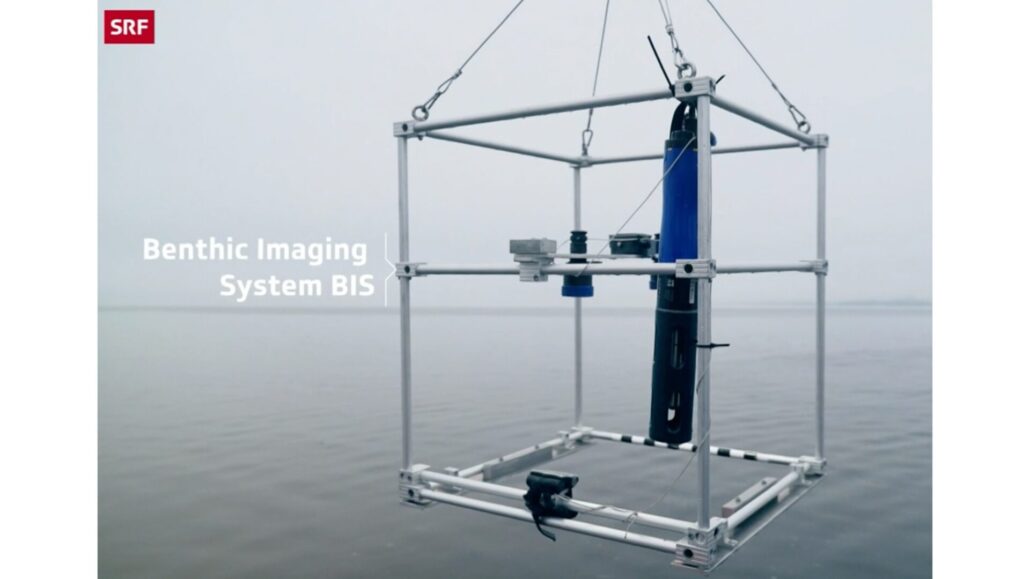
The quagga mussel (Dreissena rostriformis bugensis) is one of the most ecologically disruptive invasive species in Swiss lakes. It spreads rapidly, competes with native species for food and overgrows water-filtering infrastructure. Assessing the scale of the problem requires monitoring how much of the lakebed the mussels cover. So far conventional monitoring is slow and difficult to scale.
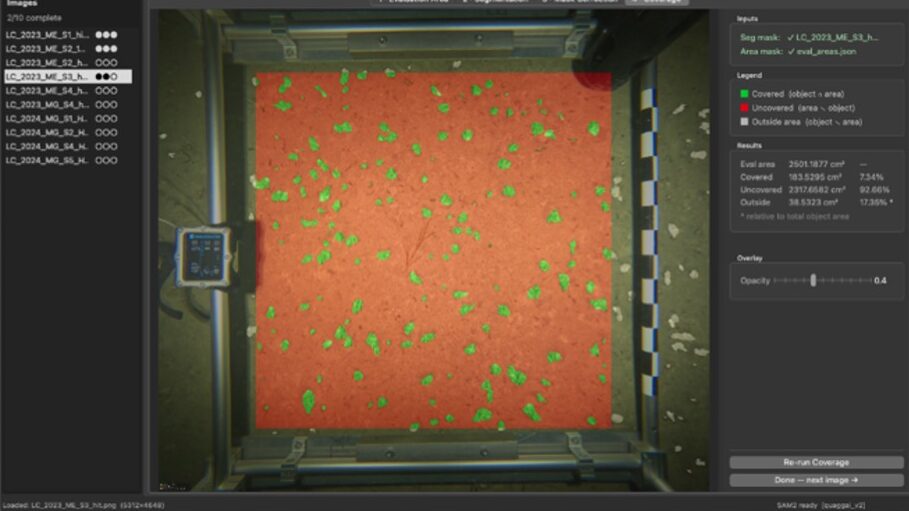
The QuaggAI project explores this problem. It applies current AI methods, in particular computer vision, to develop software prototypes that accelerate the monitoring of mussel coverage, moving from semi-automatic towards fully automatic analysis based on customised image segmentation models.
Using this ongoing research project, we designed and executed QuaggAIedu: an educational module block that brings both the ecological issue and the discussion of potential technological solutions to the high school classroom.
Educational Module Design
The module is structured into three units of two 45-minute lessons each, allowing for gradual progress in understanding first the ecological and then the technical aspects of the issue.
The first unit introduces the quagga mussel infestation issue itself: the quagga mussel as a species, the lakes already affected and, in particular, the limitations of conventional monitoring approaches. Establishing this ecological foundation helps to contextualise the technological solutions presented in the following lessons.
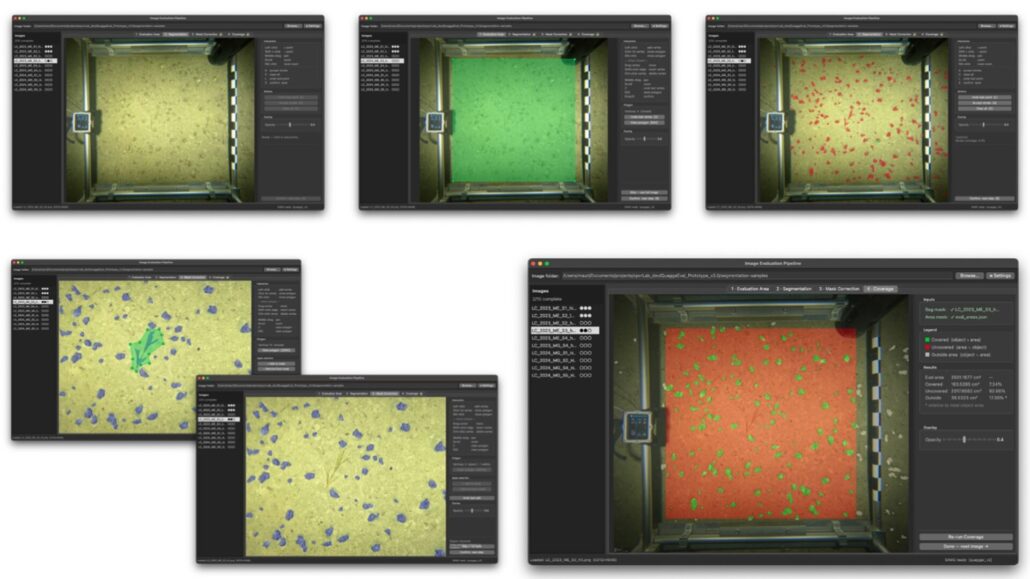
The second unit turns to the technology. It begins with the basic concepts of machine learning and image segmentation. Students understand the (high-level) process of how a model learns to identify and separate regions of interest within an image. After that, they then continue with engaging directly with the semi-automatic monitoring prototype developed within QuaggAI. This hands-on activity lets them follow the monitoring workflow step by step and develop an intuitive understanding of what the technology does and where human input remains necessary.
The third unit extends this foundation with the model training and fine-tuning process. Students work with the automatic monitoring prototype, and the session concludes with a structured critical reflection discussing the monitoring approaches presented throughout these three units.
First Execution and Insights Gained
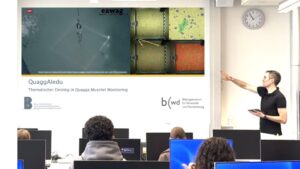
The first execution of this lecture module took place at the bwd (“Bildungszentrum für Wirtschaft und Dienstleistung”). It also pointed to where the module’s content, pacing, and interactive components need be refined for future implementations. .
One insight from this first iteration concerned the distribution of the software prototype. While the development of a local software prototype is reasonable for this stage of the project, the installation proved to be time-consuming: around 20 students each had to gain access and install the software locally, within limited time. A central next step is therefore to provide web-based access to the prototype, as this will facilitate and partially remove previous distribution and installation challenges.
Outlook
Building on the experience at the bwd, an initial exchange with the GBSL (Gymnasium Biel-Seeland) explored delivering the module as a dedicated project week. This format deepens engagement with both the ecological subject matter and the technical aspects and extends the module’s reach.
QuaggAIedu is designed to be transferable across educational contexts. It can be delivered in a standard classroom setting, like our first iteration, but also as part of project-based or out-of-classroom formats. For this purpose, we aim to make the teaching materials available to other institutions, with the goal of establishing this module as a reusable resource for science and technology education at the secondary level (“Sekundarstufe II”). In doing so, the project contributes not only to raising awareness about an ongoing ecological challenge but also to broadening access to applied deep learning concepts for school students.
References / Further Information
- Eawag: https://www.eawag.ch/de/
- SRF Doku: https://www.srf.ch/play/tv/einstein/video/invasive-quagga-muscheln-kollabierende-seen-und-millionenschaeden?urn=urn:srf:video:2a7cabb4-7471-4196-815c-3e155410cba0
- SOP Dokument: https://www.dora.lib4ri.ch/eawag/item/eawag:33819
- Bildungszentrum für Wirtschaft und Dienstleistung Bern: https://bwdbern.ch/
- Gymnasium Biel Seeland: https://www.gbsl.ch/

Maurizio Piu is a Master’s student on a Research Fellowship at BFH, studying for a Master of Science in Engineering (MSE). In his studies and research, he focuses on topics relating to the effective application of machine learning and deep learning methods, particularly in the field of computer vision.
 Christoph Paulus is a professor of computer science at Bern University of Applied Sciences and heads the Computer Vision Laboratory – which also focuses on simulations and artificial intelligence.


 Contributions as RSS
 Comments as RSS
Leave a Reply
Want to join the discussion?Feel free to contribute!