
Powering AI — Feel the Energy It Takes
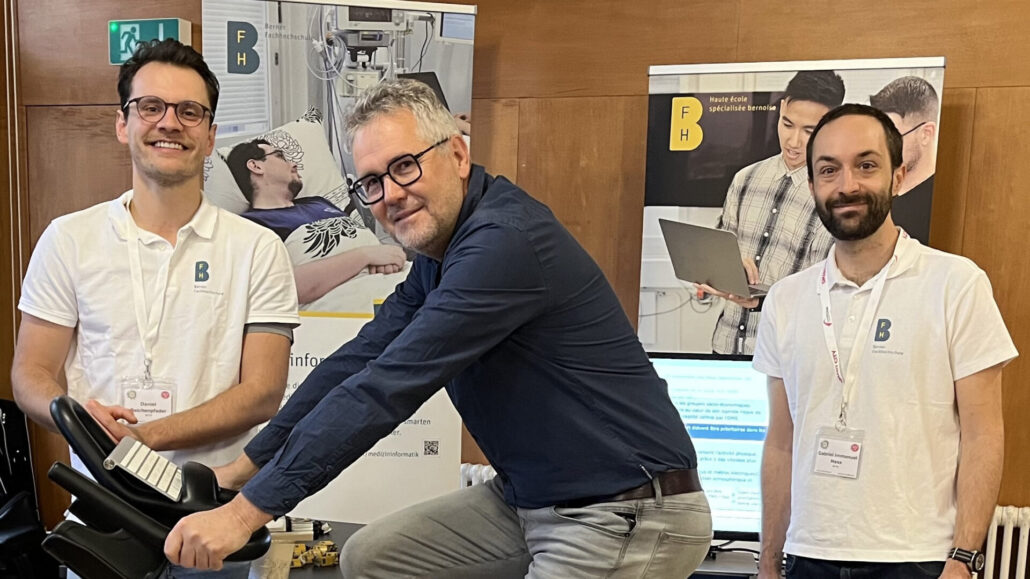

“Draft a letter of resignation for my health insurance provider” (1.7 kcal) “What could I cook with two tomatoes, an onion and a block of feta cheese (3.8 kcal)?” or “What is the Grandfather Paradox (3.8 kcal)?” These days, people are increasingly turning to AI chatbots for answers to questions like these. But how much energy do chatbots actually consume? The “enerKI” project makes this tangible in the truest sense of the word.
What an exercise bike has to do with AI
You may have heard that generative language models, such as those used in AI chatbots, are not exactly resource-efficient. Some chatbots (such as the BeeChat prototype from Bern University of Applied Sciences[1]) even state how ‘expensive’ it was to process a prompt. But even if the response includes a price tag with a figure in watt-hours, this value remains abstract and hard to visualise.
During a discussion about AI’s resource consumption in Ms Brönnimann’s coffee kitchen[2] . Daniel Reichenpfader and Gabriel Hess from the Institute for Patient-Centered Digital Health have made these abstract values tangible in collaboration with the Institute of Physiotherapy at the BFH Department of Health.
At first glance, “enerKI” looks like an ordinary chatbot. It is only after you have entered and submitted a question that the difference becomes apparent: initially, nothing happens. Instead, a prompt appears asking you to generate the required energy yourself before an answer is displayed.
To do this, an exercise bike with a power meter is connected to “enerKI”. You then need to start pedalling whilst the answer slowly appears on the screen. Depending on your fitness level and the complexity of the question entered, it takes between a few seconds and about a minute for the answer to be displayed. (Note: “The name ‘enerKI’ is a play on the German word ‘Energie’ (energy) and ‘KI’ (Künstliche Intelligenz), the German abbreviation for AI.”)
The “enerKI” on Tour project
This “enerKI” bike was presented to the public at two events in Bern and Biel. A user evaluation consistently awarded the highest rating for the overall experience. Furthermore, 71% of respondents stated that they intended to make their energy-consuming behaviour more resource-efficient in future.
A dedicated website for “enerKI” offers tips on how this can be implemented in everyday life[3]. The website also links to the “enerKI” software, which is available to anyone interested under an MIT Open Source licence. The necessary hardware and its setup are also documented to enable further use of “enerKI”.
Prompts become watt-hours … and calories
Incidentally: to illustrate the energy expended whilst pedalling in another unit of measurement, “enerKI” shows how many calories one can consume for the energy expended. Preparing the recipe for the ‘Mediterranean tomato and feta omelette’ requested at the start burns just under four kilocalories. It is precisely this shift in perspective that makes abstract electricity consumption tangible: what happens digitally in fractions of a second requires real effort in the physical world. The omelette on your plate thus provides not only enjoyment but, at least in mathematical terms, also energy for the next prompts.
Bon appétit!
How much electricity does AI really consume?
Recent studies show that AI’s energy consumption depends heavily on whether one considers individual queries or the entire system. A single text query to an AI chatbot typically requires around 0.3 watt-hours of electricity; this is equivalent to a few seconds of watching television or using an oven[4]. However, this figure varies significantly depending on model size, response length and infrastructure (up to several watt-hours per query). Training the models is considerably more energy-intensive: for example, training GPT-3 required around 1,287 megawatt-hours of electricity, which is equivalent to the annual consumption of over 100 households[5]. At the same time, total consumption is growing rapidly: data centres running AI recently consumed around 415 terawatt-hours annually and could more than double their demand to around 945 terawatt-hours by 2030. This is comparable to the current electricity consumption of an entire country such as Japan[6]. The key point here is that even though individual prompts require little energy, the consumption resulting from billions of requests worldwide adds up to a significant environmental footprint.
References
[1]https://www.societybyte.swiss/2025/07/24/beechat-die-alternative-zu-chatgpt-claude-und-co-aus-dem-herzen-der-schweiz/
[2] https://www.societybyte.swiss/2017/05/01/active-and-assisted-living-nutzen-auswirkungen-und-akzeptanz/
[4]https://www.srf.ch/news/wirtschaft/strom-fuer-rechenzentren-wie-viel-strom-braucht-kuenstliche-intelligenz
[5] Zhenya Ji, Ming Jiang, A systematic review of electricity demand for large language models: evaluations, challenges, and solutions, Renewable and Sustainable Energy Reviews, Volume 225, 2026, 116159, ISSN 1364-0321, https://doi.org/10.1016/j.rser.2025.116159.
(https://www.sciencedirect.com/science/article/pii/S1364032125008329)
[6] International Energy Agency (IEA), Report “Energy and AI”, 2025, Available at: https://iea.blob.core.windows.net/assets/dd7c2387-2f60-4b60-8c5f-6563b6aa1e4c/EnergyandAI.pdf

Daniel Reichenpfader is a tenure-track lecturer at the Institute for Patient-Centered Digital Health and is completing a doctorate in digital health at the University of Geneva. His research focuses on the application and optimisation of computational linguistics methods (including chatbots) in healthcare and education.
 Gabriel Hess is a research assistant at the Institute for Patient-centered Digital Health at Bern University of Applied Sciences. His main areas of responsibility are development (React Native, Ionic/Angular, Vue.js), FHIR design, and supervising student projects.
 Contributions as RSS
 Comments as RSS
Leave a Reply
Want to join the discussion?Feel free to contribute!